
How Do You Count Fifteens in Cribbage?
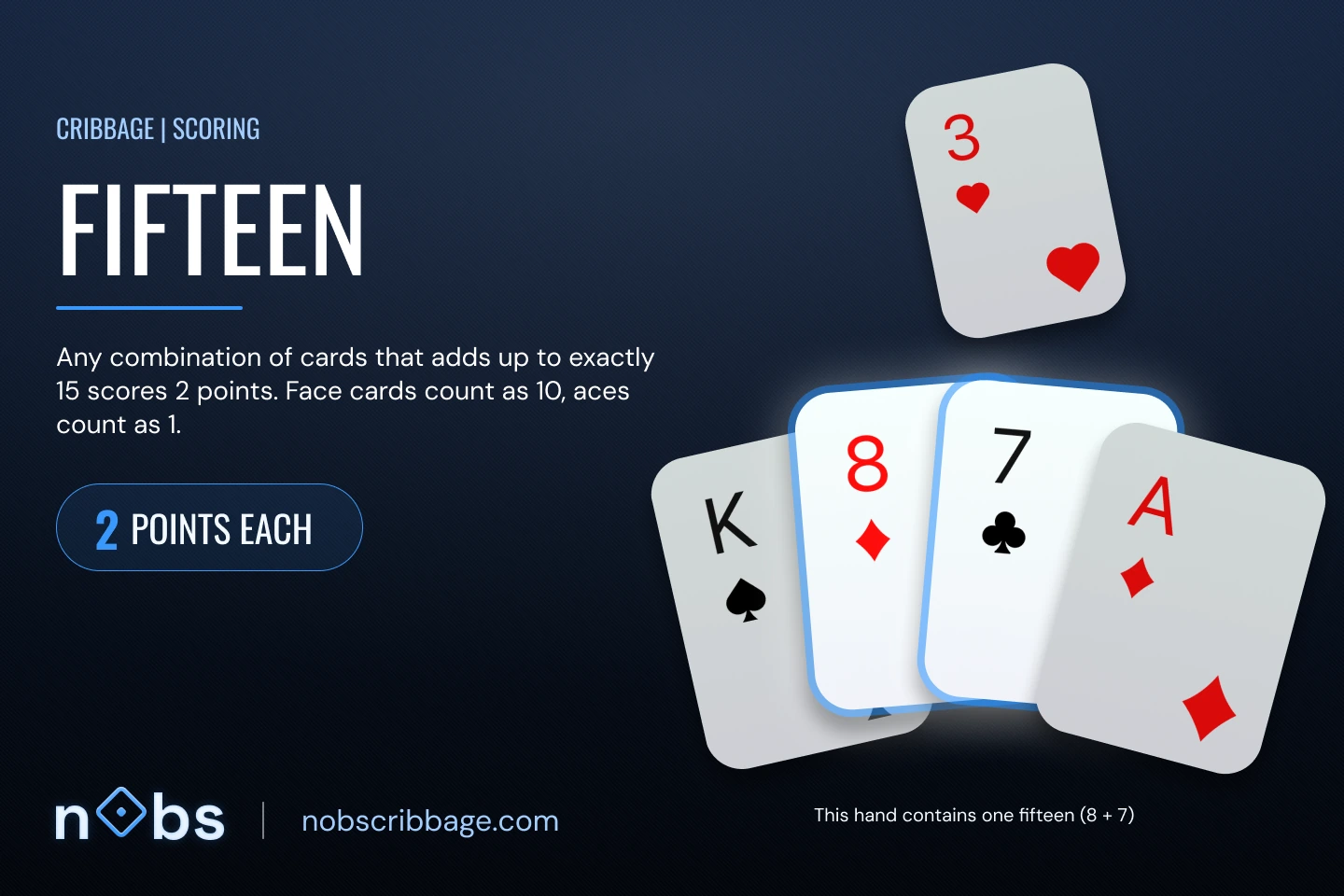
Every distinct set of cards totaling exactly 15 scores 2 points at the show, and two sets are distinct if they differ by even one card. That is why paired ranks multiply fifteens: 7-7-8 scores two fifteens for 4 points, because each 7 makes its own fifteen with the 8.
Why is 7-7-8 two fifteens and not one?
A fifteen is counted per combination, not per total. Swap the 7♦ out of 7♦ + 8♥ and put the 7♣ in its place, and you are holding a different combination of cards, so both score. Every duplicate rank that can reach 15 with the same partner adds another fifteen to the count:
| Cards | Fifteens | Points from fifteens |
|---|---|---|
| 7-8 | One | 2 |
| 7-7-8 | Two | 4 |
| 7-7-7-8 | Three | 6 |
| 7-7-8-8 | Four | 8 |
The pairs then score separately on top. So 7-7-8 is worth 4 for the fifteens plus 2 for the pair, 6 in all. Likewise, 7-7-8-8 is worth 8 for the fifteens plus 4 for the two pairs, 12 in all.
How do you find every fifteen without missing one?
The rule is simply that every distinct combination scores. The order below is a practical method for walking through them, not an official sequence:
- Count the two-card fifteens first. Only three pairings of values reach 15: a 5 with any ten-value card (10, jack, queen, or king), a 6 with a 9, and a 7 with an 8. Count each duplicate in turn as its own fifteen.
- Move up to three-card sets, then four-card and five-card sets, checking each total against 15.
- Never count the same set twice. A combination is new only if it differs from one already counted by at least one card.
- Add pairs and runs afterwards. They score on top of the fifteens; the full sequence is on how to score a hand.
What do two full counts look like?
Take the hand 7♦ 7♣ 8♥ K♠ with the 8♦ turned as starter. Each 7 makes a fifteen with each 8, and the two pairs come on top:
| Combination | Cards | Points |
|---|---|---|
| Fifteen | 7♦ + 8♥ | 2 |
| Fifteen | 7♦ + 8♦ | 2 |
| Fifteen | 7♣ + 8♥ | 2 |
| Fifteen | 7♣ + 8♦ | 2 |
| Pair | 7♦ 7♣ | 2 |
| Pair | 8♥ 8♦ | 2 |
| Total | 12 |
The king joins nothing here: no set containing it totals 15, and the hand holds no run. The count is commonly announced as "fifteen 2, fifteen 4, fifteen 6, fifteen 8, and two pairs make 12."
A triple works the same way. With 5♥ 5♦ 5♣ K♠ and a 2♦ starter, the king makes a fifteen with each 5 in turn, and the three 5s together total 15 for a fourth. That is 8 for the fifteens plus 6 for the pair royal (three of a kind), a total of 14, with the 2♦ adding nothing.
Is 4-4-7 one fifteen or two?
Just one: a single 4 with the 7 totals only 11, so both 4s have to sit in the same combination to reach 15. There is exactly one set, 4 + 4 + 7, worth 2 points. The hand 4♠ 4♦ 7♣ Q♥ with a 10♥ starter therefore counts just 4: one fifteen plus the pair of 4s.
The test is whether each duplicate can reach 15 on its own with the other cards. A 7 needs only the 8, so a second 7 brings a second fifteen; a 4 needs its twin as well as the 7, so the pair of 4s makes one fifteen between them.
Do fifteens stack with pairs and runs?
Yes: the same card may sit in a fifteen, a pair, and a run at the same time, and each combination scores in full. A triple run (a run of three with one rank tripled) counts 15 points before its fifteens, and any fifteens the cards form are added on top of that.
How many fifteens can one hand hold?
The twenty-nine hand shows how far multiplication goes: eight fifteens. Four of them are the jack with a 5 and four are 5 + 5 + 5, worth 16 of the hand's 29 points before the pairs and nobs are added.
By the Nobs Cribbage team Last reviewed 2026-08-02